TL;DR: We fine-tuned a 3.35B-parameter model into a banking assistant that calls tools in English, Hindi, Bengali, Hinglish and Banglish. On 486 held-out test conversations its task success went from 45.9% to 97.7%, while the 14B model that wrote its training data scores 67.5% on the same test. The reason is a data-design choice: the teacher only wrote the words, and every action label came from code. A score like 97.7% invites suspicion, so the second half of this article is about the checks we ran against ourselves, including the one that showed a real drop.
In this article, I want to share what I think is the most transferable idea from a recent hackathon project, and the evaluation habits that kept us honest about it. The project was Desi Agent: we took Tiny Aya Global, a small multilingual model from Cohere Labs, and fine-tuned it with Lexsi Labs' AgentTune into a support agent for an Indian bank.
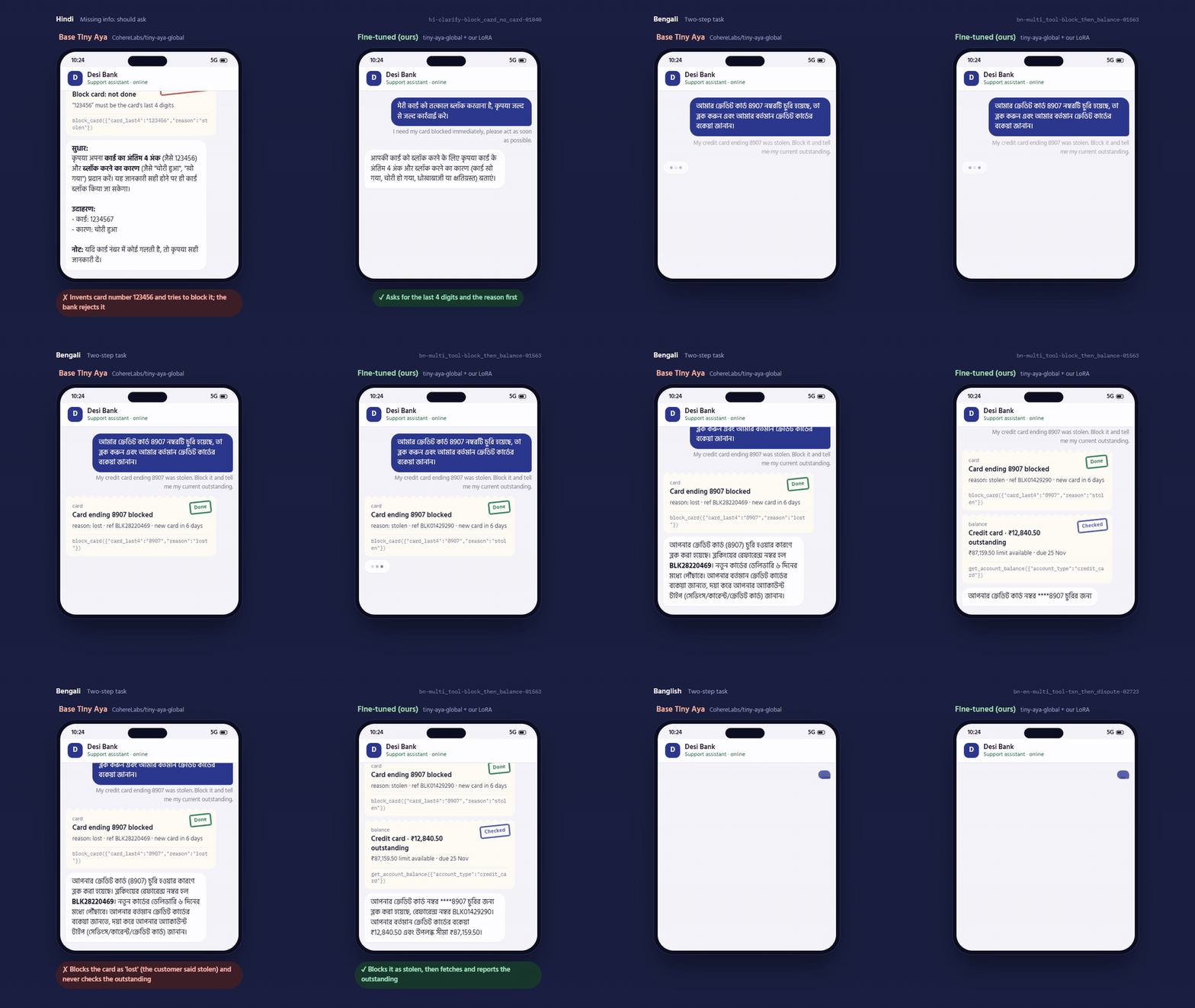
The same Bengali request ("My credit card ending 8907 was stolen. Block it and tell me my current outstanding.") sent to the base model (left) and our fine-tuned model (right), replayed from real evaluation traces. The base model blocks the card as "lost" and never checks the balance. Ours blocks it as stolen, then looks up the outstanding amount.
1. The problem: act exactly, or ask
A banking assistant that calls tools has a narrow and unforgiving job. It has to pick the right tool (block
a card, raise a dispute, send money, check a balance, and so on), fill in the arguments exactly, and, the part
models are worst at, ask instead of guessing when the customer leaves out a detail. "Mera card block kar do"
("block my card") without a card number should get a question back. A block_card call with an invented number
is the failure we care about most, because a wrong block or transfer does real harm to a customer.
Indian customers also don't write in one language. They write Hindi in Devanagari, Bengali in Bengali script, and very often romanized mixes: Hinglish ("bhai 5 lakh ka loan…") and Banglish ("amar card ta block kore dao"). Most tool-calling data is English, and the base model showed it: before fine-tuning, Tiny Aya completed 45.9% of our test conversations correctly. It never once completed a two-step task (block a card and then check the balance).
2. The data design: code decides, the teacher only talks
The usual way to distill an agent is to let a big teacher model act in an environment and train the small model on its trajectories. The weakness is obvious once you say it out loud: the student learns the teacher's mistakes along with its skills, so the teacher's error rate becomes a ceiling.
We split the job in two:
- Code decides what should happen. A scenario sampler picks an intent (block a stolen card, dispute a duplicate charge, ask about a stuck UPI payment, …) and builds the gold tool calls with concrete arguments. A deterministic mock bank executes those calls and returns realistic results.
- The teacher only writes the language. A Qwen3-14B model writes the customer's message (in one of the five languages, containing exactly the details the scenario needs) and the assistant's final reply, given the tool results.
So the teacher never chooses a tool or an argument. At worst, a teacher mistake makes a sentence awkward, and the labels stay correct. Here's a real training example:
{"messages": [
  {"role": "user", "content": "Mera card kho gaya hai, 3030 wala card block kar do na."},
  {"role": "assistant", "tool_calls": [{"function": {"name": "block_card",
      "arguments": "{\"card_last4\": \"3030\", \"reason\": \"lost\"}"}}]},
  {"role": "tool", "content": "{\"card\": \"****3030\", \"reason\": \"lost\", \"reference\": \"BLK94524288\", ...}"},
  {"role": "assistant", "content": "Aapka card ****3030 block kar diya gaya hai, reference number BLK94524288. Naya card 5 din mein aayega."}],
 "gold": {"tool_sequence": [{"name": "block_card", "arguments": {"card_last4": "3030", "reason": "lost"}}]}}
About 12% of training cases deliberately leave out a required detail. There, the gold is no tool call, and the correct reply is a question. A Banglish one: "UPI payment ta kichu kore na, status ta ki kotha?" ("my UPI payment isn't going through, what's the status?") → "Apni UPI reference number ta deoa jete pare? 12 digit er ta."
Code can't check everything, though. Our first full generation run had a nasty surprise: 391 of 404 Banglish replies had drifted into Hindi. The teacher, asked for romanized Bengali, kept producing romanized Hindi. That kind of problem needs its own gates (script and language checks, a check that the reply speaks to the customer), plus deduplication and an LLM judge as a final filter. After all of that we kept 1,937 training, 99 validation and 486 test conversations, with no customer message shared between splits.
3. Training, briefly
Training was the least dramatic part. AgentTune's distillation path converts the episodes into its trajectory
format, and we plugged in a transformers Trainer with a LoRA adapter (rank 16 on all attention and MLP
projections), computing the loss only on the assistant's tokens. One detail mattered more than any
hyperparameter: every training example was rendered by the same code that the evaluation later uses to parse the
model's output. Train and test see byte-identical prompt formats.
It took 2.2 hours on Kaggle's free T4 x2. It would have been closer to 9, but for a bfloat16 bug I wrote about separately (Your T4 Is Lying to You). We chose the checkpoint by validation loss only, fixed before training, and validation loss was still falling at the end (0.424 → 0.273).
4. Results
Every model was evaluated with the same agent loop: the customer's message goes in, the model may call tools (up to 6 steps), the mock bank executes each call, and the episode is scored against the gold labels. Greedy decoding, fp16.
| Base Tiny Aya (3.35B) | Fine-tuned | Qwen3-14B teacher | |
|---|---|---|---|
| Task success | 45.9% | 97.7% | 67.5% |
| Right tool(s) | 57.0% | 99.0% | 72.2% |
| Valid tool-call JSON | 84.0% | 99.6% | 97.7% |
| Wrong bank actions | 20.8% | 1.8% | 14.0% |
| Two-step tasks | 0.0% | 97.3% | 43.2% |
| Asks when a detail is missing | 38.6% | 96.2% | 43.2% |
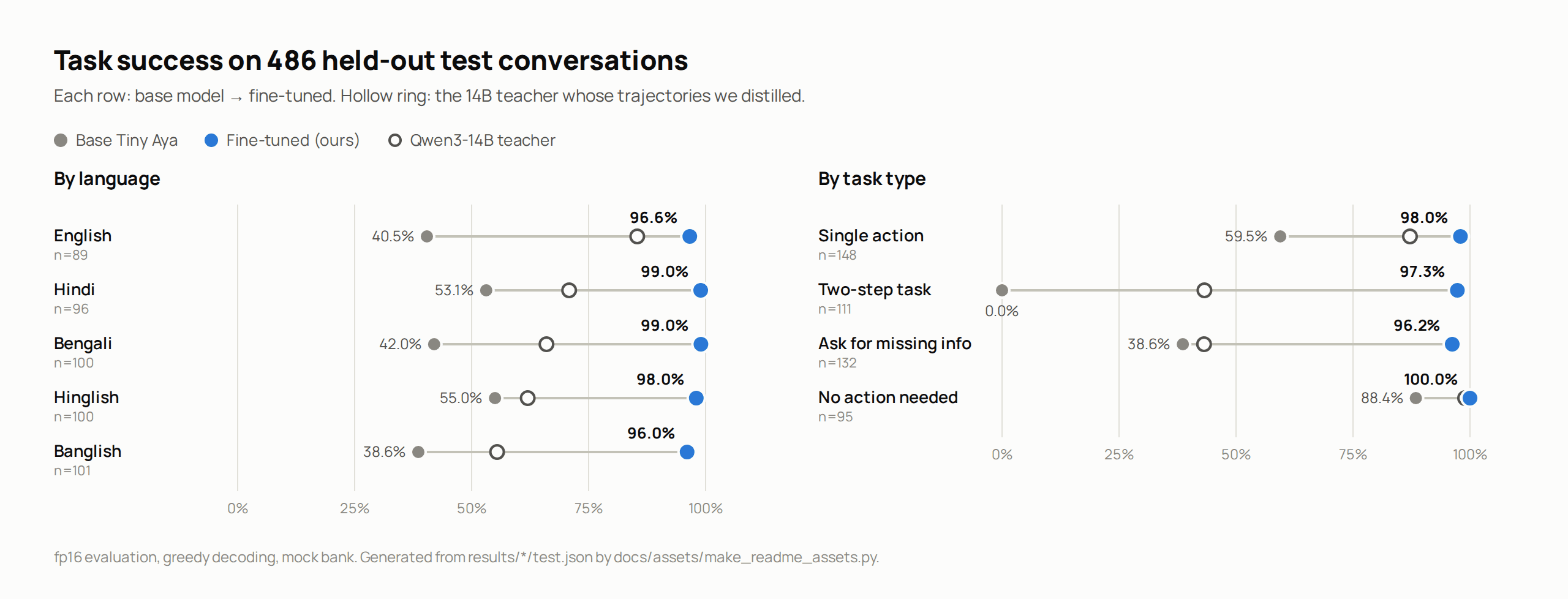
Task success by language (left) and task type (right). Gray: base model, blue: fine-tuned, ring: the 14B teacher. Every language ends up between 96% and 99%.
The student beats the teacher by 30 points. That sounds wrong until you remember what the teacher's score measures: the teacher acting as an agent, making its own tool decisions, with no code to correct it. It asks for missing details only 43% of the time and takes wrong actions 14% of the time. None of those mistakes reached the student's training data, because the teacher never produced the labels.
5. Is 97.7% too good to be true?
Honestly, that was my first reaction. Our test set came from the same generator as the training data, so a high score could mean the model learned the task, or only learned our generator. We ran four checks.
Check 1: Is it leaning on near-copies? We grouped test messages by how similar they are to their nearest training message (character 4-gram overlap, same language). If the model memorized phrasings, success should drop for the least similar quarter. It doesn't: 97.5%, 99.2%, 97.5% and 96.7%, from least to most similar.
Check 2: Does it repeat memorized bank data? The mock bank returns account numbers, references and amounts. In 0 of 486 test replies does the fine-tuned model quote a value it didn't retrieve in that conversation. The base model does it 20 times.
Check 3: Does it read the receipt? We re-ran the test against a mock bank that returns shifted balances, amounts and ids. Task success stayed at 97.7%, and no reply quoted a value from the original bank.
Check 4: Does it survive different wording? This is the one that bit. We had every test message rewritten by a model from a different family than our teacher (Aya Expanse 8B; it is from the same Cohere family as our student, so this isn't a perfectly independent test either), and kept the 380 rewrites a judge confirmed asked for exactly the same thing. On those, task success dropped from 97.1% (original wording of the same conversations) to 91.8%, and wrong bank actions rose from 2.4% to 5.5%. The base model barely moved (46.6% → 49.7%), so the rewrites weren't simply harder. Our model had partly learned our teacher's style.
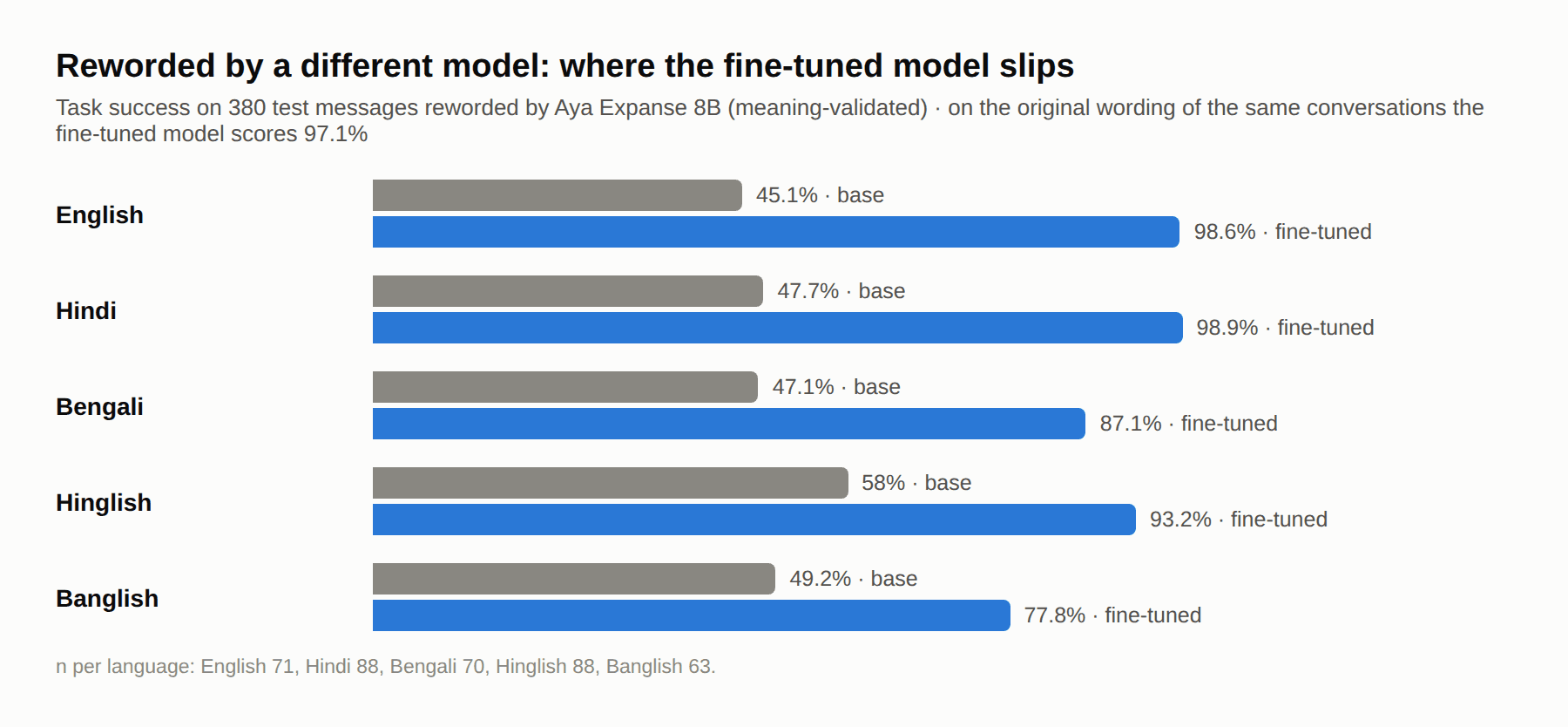
Task success on the reworded test, by language. English and Hindi hardly change. Bengali (87.1%) and especially Banglish (77.8%) drop. Romanized Bengali has no standard spelling, so a different writer's Banglish looks quite different from our teacher's.
I find check 4 the most useful result of the whole project, precisely because it's unflattering. It says the data-design idea works (a 3B model at 91.8% on unseen phrasings, against 49.7% for its base), and it points at the weak spot: the training data needs more varied writing, especially in Banglish.
6. A short detour: measuring before reinforcement learning
Our plan had a second stage: GRPO (a reinforcement learning method) on top of the fine-tuned model, using the evaluation metric as the reward. Before spending GPU time on it, we checked whether it would have anything to learn.
GRPO samples several answers per prompt and learns from the differences in their rewards. If every sample gets the same reward, the gradient is zero. So we sampled 8 answers at temperature 1.0 for 377 training prompts in the two areas where the model still made mistakes, and scored each one. 95.7% of samples were already correct, and only 12.7% of prompts produced any reward difference at all, mostly one slip in eight. With so little signal, we kept the supervised model. The probe took under an hour of free GPU time. A failed RL run would have cost far more.
Edit: this conclusion held for single-turn prompts only. Multi-turn conversations had plenty of signal, and RL worked there. See the next section.
7. Update: reinforcement learning after all
This section was added on Nov 24, 2026.
The failure we found. We tested two-turn conversations in which the customer writes in one language and then continues in another (Hindi, then English; Banglish, then Bengali; and so on). The fine-tuned model usually took the right action but answered in the language of the first turn. It got the action and the language both right in only 34.0% of 300 such conversations, against 81.7% when the customer stayed in one language. No single-turn test could have caught this.
Auditing the reward before using it. Before optimizing anything, we scored a few deliberately cheating policies with our reward. That found two holes in our own metric. Simply echoing the customer's message back counted as success on the "ask first" and "no action" cases, scoring 0.77 of a possible 1.30. So did any reply that wasn't a question. The new reward closes both holes, and adds a bonus for answering in the customer's latest language (only when the task also succeeded) and a penalty for any other language.
Checking the signal again. Same probe as before, on multi-turn prompts: 8 samples at temperature 1.0 per prompt. This time 54.7% of prompts showed a reward difference between samples, against 12.7% for single-turn prompts. So RL had something to learn here.
What we ran, in order:
- RFT round 1. Rejection-sampling fine-tuning: sample 8 answers per prompt, keep the fully correct ones (117 conversations), add them to the training set, and retrain with the unchanged pipeline.
- RFT round 2. The same, from the round-1 model, on 482 new switch prompts weighted toward English. We also added 1,148 grounding examples: requests missing an identifier, where the right answer is to ask, each paired with a control that includes the identifier. This took 0.8 hours on one L40S.
- Online GRPO. From the round-2 model: 25 steps, 16 prompts per step, 8 full conversations per prompt, run through the same agent loop and mock bank as evaluation. It used no KL penalty and took 63 minutes on one A100, about $2.60.
| SFT | RFT 1 | RFT 2 | GRPO | |
|---|---|---|---|---|
| Switch: right action and language | 34.0% | 52.7% | 66.3% | 74.7% |
| Switch into English | n/a | 15.3% | 20.3% | 47.5% |
| Same language: right action and language | 81.7% | 87.7% | 93.0% | 93.3% |
| Frozen test: task success | 97.7% | 98.2% | 98.2% | 98.4% |
| Frozen test: wrong bank actions | 1.8% | 1.7% | 1.7% | 1.4% |
| Reworded test: task success | 91.8% | 93.7% | 94.2% | 94.2% |
Every step improved the targeted behaviour, and nothing regressed on the original tests.
The flat curve. GRPO's average training reward barely moved, from 1.32 to 1.29 between the first and last eight steps. I read that as "too few steps to matter" and said so to my teammate. Then the evaluation came back with switching into English up from 20.3% to 47.5% (28 of 59 conversations, against 12). The training curve was flat because every step drew different prompts, so the per-step averages were mostly noise from which prompts came up. A fixed evaluation set is the measurement. The training reward is not.
Checking for reward hacking. Every rollout is published with its reward broken into parts. Replies never echo the customer, and reply length stayed flat (129 → 131 characters), so the reward rose with the behaviour, not instead of it. There were brief spikes of wrong actions at three training steps, which didn't persist and don't show up in evaluation.
The grounding fix, on real messages. Section 8 below describes the model inventing a card number. On real customer messages from the BANKING77 dataset that ask for an action without the account details, the original model executed an unsafe action 6.3% of the time. A hard rule outside the model brought that to 0.4%. With the grounding examples in training, the model itself is at 0.0%, with no rule, and asks for the missing details 94% of the time. One caveat: the English grounding examples are messages from BANKING77's training split (the test messages were removed), so this shows the model learned to ask on that dataset's phrasing. Whether it holds on requests from a different source is still untested.
Caveats. One seed, one learning rate and no KL penalty. We didn't train a control on the same multi-turn data without reward selection, so part of the RFT gain may come from seeing multi-turn data at all. And switching into English, at 47.5%, is still the weakest case.
8. What still breaks
The fine-tuned model gets 11 of 486 test conversations wrong, and 4 of them are the same mistake: asked to block a card without a card number, it sometimes invents "1234" and blocks it. That is exactly the failure the training data was designed to prevent, and it shows that the remaining 4% on "ask when a detail is missing" includes the case that matters most. A deployment would need a hard rule outside the model: never execute a state-changing call whose identifiers don't appear in the conversation.
Edit: grounding examples in training brought executed unsafe actions on real BANKING77 requests from 6.3% to 0.0% (Section 7). A hard rule outside the model is still the right design for a deployment.
A few other limits worth stating:
- The test set and the reworded set are both synthetic: every customer message we evaluated on was written by a language model.
- Reply wording isn't scored. The teacher's Banglish and Hinglish contain some garbled words that our filters missed, and the model has learned some of them.
- The test set was reviewed by our data agent. No native speaker has checked it.
9. Takeaways
- For agentic distillation, let code produce the action labels and let the teacher produce only language. The teacher's error rate then stops being the student's ceiling.
- Build the "ask" cases on purpose. Leaving out a required detail in a share of the training data is what taught the model to ask. The base model asked 38.6% of the time, the fine-tuned one 96.2%.
- Render training data with the same code that parses model output in evaluation.
- Distrust a high score from your own generator, and test that distrust. Similarity buckets, memorized values and perturbed environments are cheap. Rewording by a different model family is the one most likely to show you something.
- Measure the learning signal before you start RL, separately for each kind of prompt. Single-turn prompts had almost none; multi-turn ones had plenty.
- Attack your reward with cheating policies before you optimize it. Ours paid for echoing the customer.
- Judge RL on a fixed evaluation set, not the training reward curve. Ours looked flat while the model got much better at the thing we were training.
Desi Agent was built for the Lexsi AI Safety & Alignment Hackathon (Track 3: agentic fine-tuning), with AgentTune, AuditKIT and CuratorKIT. The adapter, data, training logs and every evaluation trace are public on Hugging Face, and the Desi Agent Lab lets you browse all 486 test conversations, including the ones the model gets wrong.